Showing posts with label Barak Obama. Show all posts

Thursday, June 28, 2012

Justice Scalia Truly Doesn't Give A Fuck, Does He?

Photo from the Pittsburgh Post-Gazette

Today, the Supreme Court gave a split ruling on President Obama's challenge against Arizona's controversial immigration law, S.B. 1070.  The court struck down multiple provisions, but did leave the statute that said law enforcement officials could demand to see paperwork if they suspected an individual of being an illegal immigrant.  This, of course, has lead to concerns there would be mass amounts of racial profiling.

The good news for civil libertarians like myself, is that the Court did strike down provisions that said illegal immigrants weren't allowed to seek employment, as well as a provision that allows police to make a "warrantless arrest of anyone they had probably cause to believe they made a deportable offense."

I hoped this ruling would have gone further, and activists need to push for Arizona to change the law completely.  However, in addition to sharing the news about the ruling, I also want to share a quote from the ever-modest, Justice Antonin Scalia.  Here is some of what he had to say while defending he Arizona law in his own ruling:

Notwithstanding “[t]he myth of an era of unrestricted immigration” in the first 100 years of the Republic, the States enacted numerous laws restricting the immigration of certain classes of aliens, including convicted crimi­nals, indigents, persons with contagious diseases, and (in Southern States) freed blacks. Neuman, The Lost Century of American Immigration (1776–1875), 93 Colum. L. Rev. 1833, 1835, 1841–1880 (1993). State laws not only pro­ vided for the removal of unwanted immigrants but also imposed penalties on unlawfully present aliens and those who aided their immigration.
I know Justice Scalia tends to take a more traditional view of the law, but he seems to be crossing a moral line here, especially because he is apparently citing some of these laws as precedent.

UPDATE:

The day after I wrote this post (everything above), E.J. Dionne of The Washington Post wrote an editorial saying that Scalia should resign from the Supreme Court.  On the face of it, I suppose one could say that this is just some left-wing pundit spewing out liberal rhetoric and talking points.  Well, that isn't totally inaccurate, but Dionne makes some excellent points.  As he points out, Scalia wants to be a politician or pundit as much as anyone:

Unaccountable power can lead to arrogance. That’s why justices typically feel bound by rules and conventions that Scalia seems to take joy in ignoring. Recall a 2004 incident. Three weeks after the Supreme Court announced it would hear a case over whether the White House needed to turn over documents from an energy task force that Dick Cheney had headed, Scalia went off on Air Force Two for a duck-hunting trip with the vice president.
Scalia scoffed at the idea that he should recuse himself. “My recusal is required if . . . my ‘impartiality might reasonably be questioned,’ ” he wrote in a 21-page memo. Well, yes. But there was no cause for worry, Scalia explained, since he never hunted with Cheney “in the same blind or had other opportunity for private conversation.”
Don’t you feel better? And can you just imagine what the right wing would have said if Vice President Biden had a case before the court and went duck hunting with Justice Elena Kagan?

Then there was the speech Scalia gave at Switzerland’s University of Fribourg a few weeks before the court was to hear a case involving the rights of Guantanamo detainees.
“I am astounded at the world reaction to Guantanamo,” he declared in response to a question. “We are in a war. We are capturing these people on the battlefield. We never gave a trial in civil courts to people captured in a war. War is war and it has never been the case that when you capture a combatant, you have to give them a jury trial in your civil courts. It’s a crazy idea to me.”

It was a fine speech for a campaign gathering, the appropriate venue for a man so eager to brand the things he disagrees with as crazy or mind-boggling. Scalia should free himself to pursue his true vocation. We can then use his resignation as an occasion for a searching debate over just how political this Supreme Court has become.
This is why we need to amend the Constitution and implement term limits on Supreme Court Justices.  I'm just saying . . .

Wednesday, June 20, 2012

Transparancy And Obama Asserting Executive Privilege

Photo from Huffington Post

As a civil libertarian, as well as a believer that an Obama presidency would have brought about greater government transparency with regard to the affairs of the Executive branch, President Obama's decision to exert executive privilege in order to deny requests in Congressman Darrell Issa's (R-CA) investigation into the Fast and Furious gun running program is a complete disappointment.  First, in case you don't know what the Fast and Furious program was:

The Bureau of Alcohol, Tobacco, Firearms and Explosives (ATF) ran a series of "gunwalking" sting operations[2][3] between 2006[4] and 2011.[2][5] This was done under the umbrella of Project Gunrunner, a project intended to stem the flow of firearms into Mexico by interdicting straw purchasers and gun traffickers within the United States.[6] "Gunwalking" or "letting guns walk" was a tactic whereby the ATF knowingly allowed thousands of guns to be bought by suspected arms traffickers ("gunrunners") working through straw purchasers on behalf of Mexican drug cartels.[7]
The stated goal of allowing these purchases was to continue to track the firearms as they were transferred to higher-level traffickers and key figures in Mexican cartels, in theory leading to their arrests and the dismantling of the cartels.[8][9] The tactic was questioned during the operations by a number of people, including ATF field agents and cooperating licensed gun dealers.[10][11][12][13][14] Operation Fast and Furious, by far the largest "gunwalking" probe, led to the sale of over 2,000 firearms, of which around 700 were recovered as of October 20, 2011.[15] A number of straw purchasers have been arrested and indicted; however, as of October 2011, none of the targeted high-level cartel figures have been arrested.[7]
Firearms "walked" by the ATF have been found at violent crime scenes on both sides of the Mexico–United States border, including scenes involving the deaths of many Mexicans and at least one U.S. federal agent, Border Patrol Agent Brian Terry. The "gunwalking" operations became public in the aftermath of Terry's murder.[2] Dissident ATF agents came forward to Congress in response.[16][17] As investigations have continued, the operations have become increasingly controversial in both countries, and diplomatic relations have been damaged as a result.[2]
Representative Issa has been hovering over this issue like a vulture whenever he first became Chairman of the Committee on Oversight and Government Reform.  He has submitted numerous document requests, has engaged in some cantankerous questioning of Attorney General Eric Holder in the committee hearings, and is now pushing to hold Mr Holder in contempt.  I have no doubt that one of his main motivations, if not his main motivation, in taking such a publicly strident interest in this case is politically calculated.

But as far as I can tell, Representative Issa also happens to be absolutely correct in the being so stringent in his requests. 

Could he, perhaps, scale back on the sullen-tone during committee hearings? Or to put it another way, could he not be such a dick when talking to Mr. Holder?  Absolutely.  His interactions with Mr. Holder in the Committee hearings are nothing more than cheap political theater.

But Representative Issa is absolutely doing the right thing is his insistence on investigating the Fast and Furious fun-running program, as his duties require that he does as the Chairman of the Oversight and Government Reform Committee.  It is with significant disappointment that I am aligning myself on the side of Congressman Issa over the Obama Administration on this, or any issue.

It is also disappointing that Obama is once again fighting steps for a more transparent executive branch.  The Atlantic's Conor Friedersdorf recently said this about Obama's openness to transparency (or lacktheirof) regarding leaks surrounding Obama's drone programs in the Middle East:

There is no way that this can possibly turn out well for anyone who values transparency. Either President Obama will get away with dispensing classified information in a way that advantages his side in various national-security policy debates, or there will be a crackdown, and Americans will be even less likely to get even the small amount of information we now have about U.S. actions abroad.  
As a liberal who voted for Obama in 2008 (and who hopes he wins again in 2012), I am deeply ashamed with Obama's record regarding transparency (not to mention issues surrounding civil liberties and the military, which I will address another day).  Below is a video of Obama shortly after becoming President regarding the issue of government transparency entitled "Obama: Transparency Will Be Touchstone"


My, how things do change.

Wednesday, December 21, 2011

Obama, Matt Damon, Education Policy, and Electoral Politics

 Photo from Huffington Post

In the past year, Matt Damon's support for the Save Our Schools movement has made him a favorite of teachers all over the country who are opposed to the hurtful policies implemented by so-called "education reformers" across the country.  I count myself as one of those whose personal fandom of Damon has increased for this very reason. 

Today, I was reading an article on Huffington Post where Damon criticizes Obama's failure to be more audacious and anti-establishment during his first term as president.  One of the policy areas that Damon addresses is his policies on education:
"I really think he misinterpreted his mandate. A friend of mine said to me the other day, I thought it was a great line, 'I no longer hope for audacity,'" Damon told CNN host Piers Morgan. "He's doubled down on a lot of things, going back to education... the idea that we're testing kids and we're tying teachers salaries to how kids are performing on tests, that kind of mechanized thinking has nothing to do with higher order. We're training them, not teaching them."

Everyone who supports the SOS movement, including myself, would certainly agree with Damon's words here.  We do have an over reliance on standardized testing in this country that hurts both students and teachers.  Indeed, the policies that President Obama has implemented on Education since his inauguration are, on the whole, not any better (and possibly worse) than President Bush's were.  These policies include the aforementioned testing procedures, as well as his support for funding charter schools and merit pay, and the destructive and simultaneously inefficient Race To The Top.  But what is most surprising in all of this is not Obama's support for these positions, but rather, that many of those who supported Obama in 2008 are suprised by his education positions. 

This is because President Obama's platform on education in 2008 was essentially an endorsement of the education reform movement.  For instance, he publicly supported the idea of merit pay in a speech to the National Education Association, the nation's largest teacher union, in 2007.  In addition, he was a supporter of both charter schools and school choice.  From USA Today in October, 2008:
[Obama] wants to expand federal funding for charter schools from $236 million to $450 million. He says he'd "work with all our nation's governors to hold all our charter schools accountable," adding: "Charter schools that are successful will get the support they need to grow; charters that aren't will get shut down." He also wants to expand non-profit child care, parenting and education efforts such as the Harlem Children's Zone in New York to other cities.
Just like his support for the Afghan War, Obama proposed policy initiatives on education during the 2008 campaign that are unpopular to many progressives and supporters.  But then (SURPRISE) he ended up mainly keeping his promise when entering office.  I am not sure if those who originally supported Obama thought he would renege on these particular policies when he entered office, or if they were so caught up with "Hope", "Change" and "Yes, We Can", that they didn't notice those particular aspects of his platform to begin with.  In any case, nobody who did pay attention to the Obama campaign in 2008 should be surprised at his current education policies.

To be clear, I supported Obama then (with full knowledge of his platform), and would do it again if I had to.  The prospect of a McCain presidency, or any presidency led by the 2008 GOP contenders, is too unnerving to contemplate.  I supposed I am in the category that hoped he would renege on some aspects of his education platform, but alas, he kept his word (and then some).  In addition, I hope President Obama wins reelection in 2012.  This, however, does not mean I will necessarily vote for him.  Like Damon, I am extremely disillusioned with many of Obama's policies (including education and Afghanistan), as well the continuation of the Democrat's love-affair with pussyfooting and unnecessary compromise. 

This does not mean I will vote for a Republican.  There is not a chance in hell of that given the current lineup of  pitiful and moronic contenders for the nomination, as well as the ignorant and cruel platforms that seems to be considered "mainstream" in today's GOP.  But now that I am a voter in the state of Kansas (as opposed to Missouri, where I am originally from), my vote as a progressive does not really count when voting for the Presidency.  No amount of campaigning or electioneering in the next year and a half will get the state of Kansas to elect a Democrat for the Presidency.  Not unless something happens between now and then of such earth-shattering magnitude, that Kansas electoral support for Obama in simply unavoidable.  I may, based purely on the principals I hold as a liberal, as well as being fed up with Mr. Obama, vote for a third party in the 2012 election (e.g. Green Party).  This is not final decision yet, and the President still has time to win disillusioned liberals such as myself over for an electoral landslide in 2012 (although, admittedly, that support will be more important in key swing states rather than states like Kansas). 

For starters, there is one policy proposal on education that Obama put at the center of his education platform in 2008 that he could start pushing for.  I am referring to his support for the expansion of early childhood education programs.  Here is an excerpt from the same 2008 USA Today article quoted above:

[Obama] proposes a $10 billion "Zero to Five" plan that would quadruple the number of slots in Early Head Start, increase Head Start funding and improve the quality of both; he'd make states compete to create or expand child care and education for pregnant women and children. He'd "encourage" states to adopt voluntary universal preschool; he'd expand the Child and Development Care Tax Credit, making it refundable and allowing low-income families to get up to a 50% credit for child care expenses.

We already know how important the exposure to early childhood education can be to the potential of a young person, and there chances at academic excellence in the long term.  It is somewhat surprising, and unfortunate,  that Obama has yet to pursue such a proposal during his first term (at least, as far as I know).  Perhaps he is fearful that, given the current political environment in favor of austerity and worriment over budget deficits, proposing federal spending for early childhood programs wouldn't pass, at least, without some type of backlash. 

But one thing the President is long-overdue in understanding is that there will be a backlash by Republicans in anything he proposes.  That is what the Republicans do.  He is too worried about compromising with Republicans without ever putting up a fight to begin with.   Although he has shown glimmers of hope in changing this trend in recent months, he needs to keep up, and advance the good fight.  His Presidency, as well as the good of our country, depends upon it.  A comprehensive, early childhood education bill would be a step in the right direction.  Come on, Mr. President, time to get audacious!

Sunday, October 23, 2011

Early Childhood Education, Poverty, and Occupy Wall Street

Nicholas Kristoff recently wrote a fascinating piece regarding education and the Occupy Wall Street movement.  He seems generally in favor of what the movement stands for: the desire to change economic inequality in this country.  While Kristoff doesn't belittle ideas such as raising taxes on the rich, or throwing bankers in jail, he says those ideas will not be nearly as effective to fixing the crisis of income inequality as expanding early childhood education:

But although part of the problem is billionaires being taxed at lower rates than those with more modest incomes, a bigger source of structural inequality is that many young people never get the skills to compete.  They're just left behind.
I agree with the importance of funding early childhood education (and public education in general) as a means of changing society.  After all, one of the biggest reasons why many teachers choose the career they do is to make a greater difference in society (I would include myself in this category).  I don't know if it is more important that other policy measures such as raising taxes, and passing more baking and business regulations.  But nonetheless, education is highly important.  Here is another excerpt from Kristof's column:

“This is where inequality starts,” said Kathleen McCartney, the dean of the Harvard Graduate School of Education, as she showed me a chart demonstrating that even before kindergarten there are significant performance gaps between rich and poor students. Those gaps then widen further in school.
 “The reason early education is important is that you build a foundation for school success,” she added. “And success breeds success.”
Kristof goes onto quote Nobel Prize winning economist James Heckman, who says something I'm not sure I quite agree with.
“Schooling after the second grade plays only a minor role in creating or reducing gaps,” Heckman argues in an important article this year in American Educator. “It is imperative to change the way we look at education. We should invest in the foundation of school readiness from birth to age 5.”
One's early childhood education can determine a lot about how a student will fair in school.  I would even go so far to say that early childhood education does have a bigger impact on a child's education than upper elementary and secondary education does.   But I am skeptical that schooling from grades 3 and up only play a "minor role". 

Admittedly, I have not read Heckman's article, and I am sure he has good data and points to support his assertion.  But how can 10 additional years in school be considered a minor?  How are we defining what important vs less important?  I am not saying Heckman is wrong, I am just skeptical of his assertion.

Kristof also discusses the importance of the Head Start program.  I know multiple educators who like to criticize Head Start (and rightly so to a point) because of the long term ineffectiveness the program seems to have on a child's education.  While Kristoff admits the program has faults, he also shows that it is far better to have Head Start than nothing at all, showing the need for early childhood education:


Take Head Start, which serves more than 900,000 low-income children a year. There are flaws in Head Start, and researchers have found that while it improved test results, those gains were fleeting. As a result, Head Start seemed to confer no lasting benefits, and it has been widely criticized as a failure.

Not so fast.
One of the Harvard scholars I interviewed, David Deming, compared the outcomes of children who were in Head Start with their siblings who did not participate. Professor Deming found that critics were right that the Head Start advantage in test scores faded quickly. But, in other areas, perhaps more important ones, he found that Head Start had a significant long-term impact: the former Head Start participants are significantly less likely than siblings to repeat grades, to be diagnosed with a learning disability, or to suffer the kind of poor health associated with poverty. Head Start alumni were more likely than their siblings to graduate from high school and attend college.

Finally, Kristoff finished his column by discussing President Obama's need to fulfill his 2008 campaign promise of greater funding for early childhood education. 


President Obama often talked in his campaign about early childhood education, and he probably agrees with everything I’ve said. But the issue has slipped away and off the agenda.
That’s sad because the question isn’t whether we can afford early childhood education, but whether we can afford not to provide it. We can pay for prisons or we can pay, less, for early childhood education to help build a fairer and more equitable nation.

It is surprising that no one other columnists or pundits have brought this up.  Not that the Republicans will let him pass new spending on this, but Obama should at least try.  He also needs to quit supporting asinine measures such as Race To The Top and merit pay which only hurts education.  Like a lot of those on the "education reformer" side of the debate, I believe the President has good intentions when it comes to what education in America should look like.  But the reality of his education policies so far only hurt schools because they do so much to hurt teachers and push standardized testing.  This is not the way to fix American education, and it is damn sure not the way to help combat poverty in the long run.

Sunday, October 9, 2011

A Video for Sunday: Socialism/Occupy Wall Street Edition


This week, I am providing a double dose of videos.

I recently had the immense pleasure of listening to Upton Sinclair's The Jungle on audio book.  It's a novel about a Lithuanian family that moves to Chicago trying to find the American dream at the beginning of the 20th century.  What they actually find is personal and economic hardships not to be wished upon anyone.  Numerous events of a devastating nature crush the family into the lowest depths of despondency and poverty.  By the end of the novel, the main character, Jurgis Rudkus, realizes that evils of American capitalism and finds grace in supporting the socialist movement.  The novel was Sinclair's attempt for the American people to look at the evils of American economic system, and realize that socialism is the direction the country needed to head in.  Here is a video, originally posted on TeacherTube, that talks about the book a little more in depth, and what the real legacy of the book actually came to be after it was published. 


This book, as well as the the ever-growing Occupy Wall Street protests, provides a good opportunity to re-look at socialism.  For the longest time, the word "socialism" has had a dirty connotation to it in the United States, and even more so from the American right ever since Obama took office.  When people hear the term, they equate it with communism.  Images of the Soviet Union, Maoist China, and Che Guevera come to many American's minds.  But the reality is that most developed countries around the world, including the United States, have socialism in their economic system to a certain point.  Except unlike other countries in the world, socialism is generally not the evil, dirty word that it is in the United States.  And truth be told, many of us who do call ourselves socialists wouldn't advocate government takeover of all industries and private property (like some claim).  Most socialists (including myself) would probably prefer a type of mixed economic system: a capitalist/socialist hybrid where great emphasis is placed on economic equality, worker's right, and protections in case something bad happens to one of it's citizens (e.g. health care, unemployment benefits, etc.)  Here is a clip from a while ago by MSNBC's Lawrence O'Donnell on the the use of the word "socialist" to describe himself.


It should be noted that not all those who support the Occupy Wall Street movement are socialists.  What those of us who do support these demonstrations agree upon is that damage that the banks and corporations have done to our economy, and that something needs to be done about the way they do business.  It is a grave injustice that in this economy, corporations are receiving record profits, CEOs and other corporate executives are receiving bonuses, and more corporate cash than ever is being filtered into our political system (among so many other things).  All the while, no new jobs are being added to our economy, and millions of American's are suffering economic hardship, and are worried that they will never be financially secure again.  I won't say we have it as rough as Jurgis and his family did in the early 20th Century, but it is still quite bad, and we deserve better.

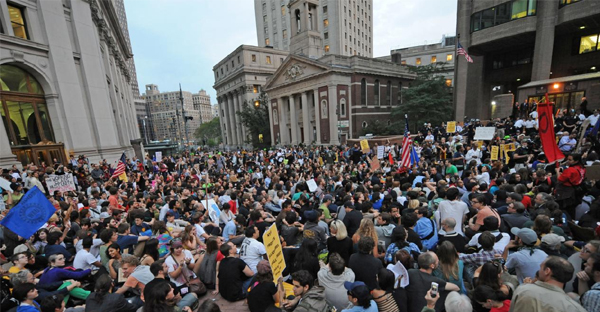
Photo from rrstar.com

There are those (myself included) who support the movement, but have expressed criticism to protesters on a couple of different points.  First, the protest needs to broaden it's marchers so that it will be more than just "hippie-types".  While it is perhaps unfair to classify all of those involved with such a stereotype (and we should be grateful to those "hippie-types" for getting the protest off the ground), this is a movement that has grown into something big.  If we really are the "99ers", and we really want to make a significant change in our system, our movement must go mainstream, and try to bring in more than those from the activist left.  We need to bring in average citizens who may normally not be involved with political issues  These can be liberals, socialists, fed up capitalists, moderates, maybe even some conservatives.  We need to grow and unify.

A second criticism is that, while those who are protesting are clearly angry at the actions of Wall Street, they must also be able to come up with some specific, concrete ideas for policy change.  Hopefully, this movement is young, and when it comes to the potential to create change, the sky is the limit.  However, Eric Stetson at Daily Kos has some good ideas for short term changes:


1. A bailout for homeowners who are facing foreclosure and unemployed people with student loan debt -- of equal or greater value as the bank bailouts. Give these people a fresh start by forgiving their debts and keeping them in their homes, and thus improving the economy for all.
2. The "Buffett Tax" (i.e. taxing capital gains at the same rate as income earned from a job, so that working people won't pay higher taxes than the idle rich). It's only fair! And this will help to fund #1.
3. A short-term trading transaction tax for people and financial institutions who use Wall Street as a casino. Such a tax could raise huge amounts of money to fund #1, and would likely reduce the volatility in the markets by making computerized "high frequency auto-trading" by large investment companies less profitable. Such a tax would also make it harder for already-wealthy institutions to "vacuum up" more and more money from the productive sectors of the economy into the black hole of their own coffers.

Monday, February 14, 2011

Could Iran Be The Next Egypt?

The last time I wrote about Egypt, Mubarak said he wouldn't run for office in September, but he wasn't stepping down either.  I wrote that it wouldn't be a matter of if, but when Mubarak stepped down from power.  Now, of course, Mubarak is gone, and the question everyone is asking is "what is next for Egypt"?  For the time being, we should allow Egypt to have their moment.  The people of Egypt have earned this after 30 years of corrupt and dictatorial rule.
Photo from The Atlantic Council 


Just so people remember that blood was shed in this revolution, here is a website to remember those that died during the protests of the past few weeks.

Another question people are asking is, "Who Is Next?"  Based on the events in both Egypt and Tunisia, some believe that pro-democracy movements will continue to spread across Muslim and Middle Eastern countries.  One country that has naturally been mentioned as a possibility of a new revolution taking place is Iran.  While I don't want to make any presumptions, it would not be so crazy at this stage to suggest a pro-democracy revolution could take place there.  If you are not familiar with the Green Uprising after the 2009 elections in Iran, familiarize yourself NOW.  For starters, here is the Wikipedia web page to look at explaining the events.


And according to news sources, it appears that anti-government protests are already being planned for Monday in Tehran.  Again, I don't want to be presumptuous, but revolution in Iran is not out of the question.
 
I understand that from a strategic, foreign policy standpoint, there is not much President Obama can do (nor should he do).  However, there really is nothing more American than what is going on across the world today.  While these are different times, and these revolutions are taking places in different parts of the world for their own unique causes, I can't help but think of the American revolution whenever I see Tahrir Square or the Green Uprising.  The following words from our Declaration of Independence seem so applicable to what is going on today:

We hold these truths to be self-evident, that all men are created equal, that they are endowed by their Creator with certain unalienable rights, that among these are life, liberty and the pursuit of happiness. That to secure these rights, governments are instituted among men, deriving their just powers from the consent of the governed. That whenever any form of government becomes destructive to these ends, it is the right of the people to alter or to abolish it, and to institute new government, laying its foundation on such principles and organizing its powers in such form, as to them shall seem most likely to effect their safety and happiness. Prudence, indeed, will dictate that governments long established should not be changed for light and transient causes; and accordingly all experience hath shown that mankind are more disposed to suffer, while evils are sufferable, than to right themselves by abolishing the forms to which they are accustomed. But when a long train of abuses and usurpations, pursuing invariably the same object evinces a design to reduce them under absolute despotism, it is their right, it is their duty, to throw off such government, and to provide new guards for their future security.

On a side note, to those in the Tea Party who compare themselves to the Minutemen and think the Obama Administration is oppressing you and infringing upon your rights, I have this to say: Go talk to someone who has lived under the Mubarak regime or who lives in Iran, and compare and contrast what life is like for them and for you.  See who really has it rough.

Finally, check out this video in support of the Green Uprising in Iran.  While I am not a big fan of this particular Muse song, I do enjoy the video and the passion it evokes.