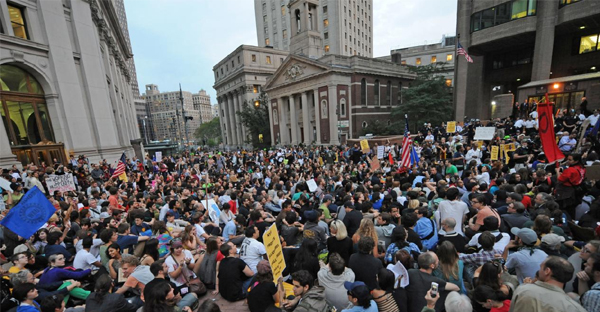
I know I am a couple of weeks late writing on this story, but I would just like to take a moment to give credit to Time Magazine's choice for the 2011 Person of the Year: The Protestor.

Photo from Huffington Post
Clearly the biggest news story of the year were the protests that arose in the Arab World, and that soon spread to other parts of the globe as well (including in the United States with the Occupy Wall Street movement). Discontent at those in charge is something that so often gets talked about, but very little ever get's done about it. Sometimes, a person get's kicked out of elected office, and the next person to replace them is either just as ineffective, or worse than the person they replace. Occasionally, you see a massive uprising against one's government in a foreign country, but that ultimately falter via government crackdown through brutality and fear (e.g. Iran, 2009).
But this year was different. Why this year, and not any other year? It is hard to say. Time Magazine writer Kurt Anderson writes this:
It's remarkable how much the protest vanguards share. Everywhere they are disproportionately young, middle class and educated. Almost all the protests this year began as independent affairs, without much encouragement from or endorsement by existing political parties or opposition bigwigs. All over the world, the protesters of 2011 share a belief that their countries' political systems and economies have grown dysfunctional and corrupt — sham democracies rigged to favor the rich and powerful and prevent significant change. They are fervent small-d democrats.For most years, Time would bestow this distinction to one individual, but in more recent years, it seems they have given the "person" of the year (singular) to groups of individuals. Examples include "The Peacemakers" (1993; represented Yasser Arafat, F.W. de Klerk, Nelson Mandela, and Yitzhak Rabin), "The American Soldier" (2003), and the lazy and pandering "You" in 2006 (representing people who post things on the internet). Of course, this year falls under that category of multiple winners as "Person of the Year", and "protesters" they couldn't have picked a more appropriate choice.
But what if you did have to pick just one person to represent the whole protest movement? Quite a daunting task considering that the number of individuals involved in protest movements around the world this year are (at a minimum) in the hundreds of thousands, if not in the millions. In addition, there is not one person who is primarily in charge of any of these movements, nor one individual that is the "face" of any of these movements, other than the faces of some of the despots who the protestors are demonstrating against to begin with (e.g. Mubarak, Gaddafi, Putin, etc.). These were truly democratic movements in every sense of the word. But there is one person, however, that can earn this distinction, because without him, all of these demonstrations may have never even started (or had the impact that they did).
Many people have suggested (and I happen to agree) that the Person of the Year for 2011 is the man in the picture at the top of this post: Mohamed Bouazizi. Who is, or rather, who was Mr. Bouazizi? Here is a description from an article on him from the website African Success, where I also copied the picture from above:
Mohamed Bouazizi was a Tunisian street vendor born March 29,1984- died January 4,2011, poured petrol over himself on December 17, 2011 and set himself, alight in front of the office of the Governor of his region, life turned upside down in Tunisia and the fires that he lit has burned until it engulfed the entire country from town to town.

Photo from African Success
He was a student from Sidi Bouzid and upon his father’s death, was obliged to stop his studies and find a job.Faced with the difficulty of finding a job, he ended up becoming a street seller, without official authorisation and desperate he plied his trade as best he could.The tragic story and suicide of Mr. Bouazizi lead to the ousting of Tunisia's president, and that could have been the end of the story. A small story of and tragedy and triumph for justice in a small African country took place, but the rest of the world kept going along with business as usual. But that did not happen. Here is a piece from an article Reuters on why the The Times of the United Kingdom named Mr. Bouaziz their Person of the Year:
His plight echoed the hapless fate of so many thousands and thosuands of young Tunisians, seduced by the promises of western education, yet frustrated and thwarted by a visionless, un-productive, corrupt power structure which dominated the country and suffocated creativity and innovation.
In Tunisia, the President Zine el_Abidine Ben Ali and his family rules his country with an iron bar.
Papers to do this and that, land to build houses on, authorisations of all sorts were obtained by the ‘kind patronage’ of the President and his family.
Mohamed didn’t have the right papers and on the 17th December[2010] the police confiscated his good and threw him out of the market because he wasn’t paying the right dividends to the people the President had put in place. Apparently slapped on the face by Faida Hamdy, it has been upheld that the indignation was the 'spark' that led to him setting fire to himself. Her family have always upheld that she never touched him and a witness who had originally affirmed that she did slap him and has since added that it wasn't true that she didn't slap him.
Mohamed decided to protest by the only means he knew and poured petrol on himself, took out his lighter and burnt himself, becoming the hero and initiator of the ‘Jasmin revolution,’ which brought down the President and his family on 14 January 2011 and made him a martyr and hero of the nation.
Bouazizi' death from his wounds in January prompted protests across Tunisia, forcing autocratic President Zine Al-Abidine Ben Ali to flee the country. Soon afterwards, millions took to the streets in Egypt, Libya, Syria and elsewhere to protest against repression, corruption, poverty and joblessness.
The uprisings unseated despots in Libya, Egypt and Yemen as well as Tunisia, while Syrian leader Bashar al-Assad's writ is disintegrating and other authoritarian rulers in the region are eyeing the tide of public anger with nervousness.
Tunisia has since elected new leaders through peaceful democratic elections.
In an October interview with Reuters, Bouazizi's mother Manoubia urged the new leaders to honor her son's sacrifice by helping poor people like him.
"Nothing would have happened if my son had not reacted against voicelessness and a lack of respect," she said.
"But I hope the people who are going to govern will be able to keep this message in mind and give consideration to all Tunisians, including the poor."

Photo from Reuters
Without the death of Mr. Bouazizi, not only would there have not been an uprising in Tunisia, there probably would have been no Tahrir Square, no Arab Spring, no Indignant's protest in Spain, no austerity protest in Greece, no protests on the Kremlin and no Occupy Wall Street. Without Mr. Bouazizi, both Hosni Mubarak and Moammar Gaddafi would probably still be in power, and it is possible that no one in America would be talking about the wealth disparity between the 99% and the 1%.
While I sincerely hope that no one ever imitates the drastic actions that Mr. Bouazizi took, we who care about these protest movements need to realize what he did, why he did it, and pay tribute to him and what has happened since then. May the memory of Mohamed Bouazizi live on. And may the movements around the globe that he helped create continue to gain momentum in 2012 and beyond!