Showing posts with label Socialism. Show all posts

Wednesday, June 27, 2012

Happy Birthday, Helen Keller

Photo from Wikipedia

This amazing woman was born today 132 years ago.  She is most famous as being the deaf and blind girl that learned how to communicate when she was taught by Annie Sullivan (also an amazing woman, and one of my inspirations as a special education teacher).  This was story was famously depicted in the play and movie, The Miracle Worker.  Keller went on to college, and would eventually become the first deaf and blind person to receive a Bachelor of Arts degree.

Picture of Keller (left) and Annie Sullivan (right) from Spartacus Educational

As amazing as her story is, it is only part of the story.  Historically, she is simply by most known as a deaf and blind woman who could talk and become educated.  What most people don't know is that throughout her adult life, she spent her time traveling the globe as an activist.  Among other things, she campaigned in for Women's Suffrage, Labor Rights, and was member of the anti-war movement in the lead up to World War I.  She was even a member of the Socialist Party of America.  That's right: Helen Keller was a Socialist.

Photo from Huffington Post

As Education Professor Ruth Shagoury points out in a recent piece on Huffington Post, most people don't know the real history of Helen Keller (but should):

If I were creating Hero trading cards for Helen Keller, I would include her passionate work for women's voting rights, and against war and corporate domination. And I'd include her courageous quotes where she asks tough and impolite questions: "Why in this land of great wealth is there great poverty?" she wrote in 1912. "Why [do] children toil in the mills while thousands of men cannot get work, why [do] women who do nothing have thousands of dollars to spend?"
Sounds to me like the mother of today's Occupy Movement.
From publishers like Scholastic Teaching Resources -- which uses her life events to "give children practice reading a timetable" by asking insipid questions such: "How can you use the first two dates to figure out Helen's age at the time she got sick?" -- to St. Aidan's Home School pages, which encourages teachers to show "the Disney version of the The Miracle Worker," the information on-line portrays the same individualistic and socially empty Helen Keller myth.
It takes a little more digging, but I encourage parents and educators to turn to resources like the small press book Helen Keller from Ocean Press's series Rebel Lives, which includes excerpts from her writings on disability and class, socialism, women, and war, or the fine young adult biography Helen Keller: Rebellious Spirit by Laurie Lawlor. It's time to share with children Helen Keller's remarkable adult life. As a defiant rebel, she could be a true hero for 21st century activists.
Indeed, schools should teach about Ms. Keller (her whole biography).  She is an excellent role model for all students: girls, boys, disabled and non-disabled.  Helen Keller is a truly remarkable figure, both for overcoming her adversity, as well as her dedication to social justice.

Sunday, October 16, 2011

MLK, Poverty, and Occupy Wall Street

Picture of Martin Luther King at a march for sanitation workers in Memphis.  Photo comes from San Francisco Bay View website.

Today, nearly everyone from every political background admires King.  But if King were alive today, he probably would have been called a "a left-wing nut", a "socialist", and even "anti-American".  And just like the Occupy Wall Street movement today, King was considered both radical and controversial during his time.

Today, the Martin Luther King Jr. Memorial had it's long-awaited dedication.  It is only by coincidence that the Occupy Wall Street movement is gradually increasing support across the country, and around the world.  There is no doubt that today, MLK would not only support the movement with his words, but would be right there with the protesters risking arrest.

Indeed, right before he was assassinated, King had helped organize the "Poor People's Campaign", which was focused on economic justice in the United States.  43 years later, the Occupy Wall Street movement is protesting economic justice in a similar manner as the protests King was involved in, but under different circumstances.  Just as Americans all love Martin Luther King now, and realize how right he was, will America look back to the supporters of the Occupy Wall Street movement in 40 years, and realize how right they are?  I can only hope so.

Here is a link to a YouTube video from a few months back by the amazing Tavis Smiley. He discusses the vital need for American politicians to tackle the issue of poverty (he quote King at the beginning of the video).  This was made before the Occupy Wall Street movement, but it does allude to the disgusting fact that so much wealth in America (the richest, most powerful nation in the history of the world), is occupied by the richest 1%.  This is one of the main things the Occupy Wall Street protesters are standing up against.

Sunday, October 9, 2011

A Video for Sunday: Socialism/Occupy Wall Street Edition


This week, I am providing a double dose of videos.

I recently had the immense pleasure of listening to Upton Sinclair's The Jungle on audio book.  It's a novel about a Lithuanian family that moves to Chicago trying to find the American dream at the beginning of the 20th century.  What they actually find is personal and economic hardships not to be wished upon anyone.  Numerous events of a devastating nature crush the family into the lowest depths of despondency and poverty.  By the end of the novel, the main character, Jurgis Rudkus, realizes that evils of American capitalism and finds grace in supporting the socialist movement.  The novel was Sinclair's attempt for the American people to look at the evils of American economic system, and realize that socialism is the direction the country needed to head in.  Here is a video, originally posted on TeacherTube, that talks about the book a little more in depth, and what the real legacy of the book actually came to be after it was published. 


This book, as well as the the ever-growing Occupy Wall Street protests, provides a good opportunity to re-look at socialism.  For the longest time, the word "socialism" has had a dirty connotation to it in the United States, and even more so from the American right ever since Obama took office.  When people hear the term, they equate it with communism.  Images of the Soviet Union, Maoist China, and Che Guevera come to many American's minds.  But the reality is that most developed countries around the world, including the United States, have socialism in their economic system to a certain point.  Except unlike other countries in the world, socialism is generally not the evil, dirty word that it is in the United States.  And truth be told, many of us who do call ourselves socialists wouldn't advocate government takeover of all industries and private property (like some claim).  Most socialists (including myself) would probably prefer a type of mixed economic system: a capitalist/socialist hybrid where great emphasis is placed on economic equality, worker's right, and protections in case something bad happens to one of it's citizens (e.g. health care, unemployment benefits, etc.)  Here is a clip from a while ago by MSNBC's Lawrence O'Donnell on the the use of the word "socialist" to describe himself.


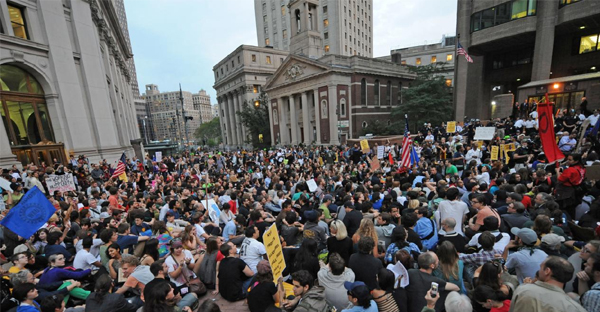
It should be noted that not all those who support the Occupy Wall Street movement are socialists.  What those of us who do support these demonstrations agree upon is that damage that the banks and corporations have done to our economy, and that something needs to be done about the way they do business.  It is a grave injustice that in this economy, corporations are receiving record profits, CEOs and other corporate executives are receiving bonuses, and more corporate cash than ever is being filtered into our political system (among so many other things).  All the while, no new jobs are being added to our economy, and millions of American's are suffering economic hardship, and are worried that they will never be financially secure again.  I won't say we have it as rough as Jurgis and his family did in the early 20th Century, but it is still quite bad, and we deserve better.

Photo from rrstar.com

There are those (myself included) who support the movement, but have expressed criticism to protesters on a couple of different points.  First, the protest needs to broaden it's marchers so that it will be more than just "hippie-types".  While it is perhaps unfair to classify all of those involved with such a stereotype (and we should be grateful to those "hippie-types" for getting the protest off the ground), this is a movement that has grown into something big.  If we really are the "99ers", and we really want to make a significant change in our system, our movement must go mainstream, and try to bring in more than those from the activist left.  We need to bring in average citizens who may normally not be involved with political issues  These can be liberals, socialists, fed up capitalists, moderates, maybe even some conservatives.  We need to grow and unify.

A second criticism is that, while those who are protesting are clearly angry at the actions of Wall Street, they must also be able to come up with some specific, concrete ideas for policy change.  Hopefully, this movement is young, and when it comes to the potential to create change, the sky is the limit.  However, Eric Stetson at Daily Kos has some good ideas for short term changes:


1. A bailout for homeowners who are facing foreclosure and unemployed people with student loan debt -- of equal or greater value as the bank bailouts. Give these people a fresh start by forgiving their debts and keeping them in their homes, and thus improving the economy for all.
2. The "Buffett Tax" (i.e. taxing capital gains at the same rate as income earned from a job, so that working people won't pay higher taxes than the idle rich). It's only fair! And this will help to fund #1.
3. A short-term trading transaction tax for people and financial institutions who use Wall Street as a casino. Such a tax could raise huge amounts of money to fund #1, and would likely reduce the volatility in the markets by making computerized "high frequency auto-trading" by large investment companies less profitable. Such a tax would also make it harder for already-wealthy institutions to "vacuum up" more and more money from the productive sectors of the economy into the black hole of their own coffers.