Showing posts with label Economics. Show all posts

Wednesday, November 23, 2011

Thanksgiving, 2011

Tomorrow, I will be going to Iowa to celebrate Thanksgiving with some of my wife's family.  It is a tradition that we have done every year since we were engaged, and one I have grown to love dearly.  It is a wonderful time to see members of her family I don't get to see very often.  It is also a time to relax and unwind. I get a few days off to stuff my face with food, shop, and otherwise, take it easy (I usually catch up on a lot of reading on this trip).  


So I am definitely thankful for that.  But there are plenty of other things I am thankful for this year:

  • I am thankful for the fact that my wife and I are both now working.  While I would certainly prefer to have an actual teaching job, I am just glad to still be working at all (especially given what a tough year we have had).  I feel very confident that my current position will lead to something better, and we are so fortunate to have the jobs we do given the our economic situation.   Speaking of which . . .
  • I am thankful that we are in a decent spot financially.  No, not great; not even that good; but decent.  As I said, we are both working, and we are able to make ends meet.  We are making enough that we are somewhat financially secure from month-to-month.  Hopefully, we can get to a point where we can afford a house, as well as afford to have a child.  Mentally and emotionally, we are ready for both.  But we have to be patent for now.  We are, however, a lot more financially secure than we were when we first got married.  We were basically broke, but we have been able to save since then.  And as with out job situation, we could be a lot worse off given how so many other people are doing in our country.  While we are discussing economics . . .
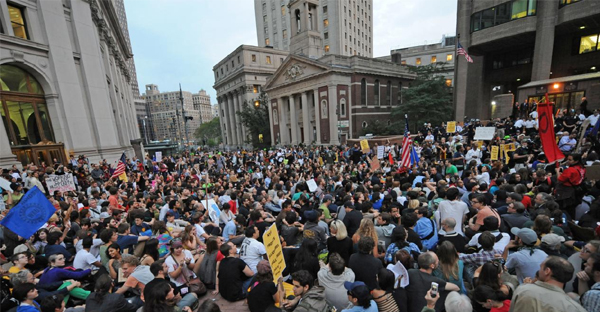
  • I am thankful for the Occupy Wall Street movement.  I won't say I agree with everything they are doing, and I sometimes wish they had more specific ideas (like these).  But it is long overdue that a movement such as this exists.  By that, I mean people actually marching in the streets and bringing attention to all of the damage done by the excesses and deregulation of our economic system.  I don't know what reforms will ultimately come of this movement, but I know that there are a lot of dedicated people who will keep it going. 

  • I am thankful for Weight Watchers.  That's right, Weight Watchers  I've been on the diet 2 months, and have almost lost 10 pounds.  I am sure I would have lost a lot more if I exercised more than 3 times a week.  I have tried for years off and on to lose weight, but this is the only thing that has really worked so far.  I won't say it's for everyone.
  • I am thankful that an old fraternity brother and one of my best friends became a father yesterday.  I mean this especially because I know he has had some of his own personal struggles in recent years, but now seems more focused and at peace than he ever has.  I can't wait to visit him and see the baby.
  • I am thankful that after months of going back and forth between a physical rehabilitation program and the hospital, my grandmother has finally settled into a proper nursing home.  And she seems happy about being in the nursing home, which is a pleasant surprise.
  • I am thankful for books (especially my new Kindle), video games, and movies.  OK, that is the lazy, materialistic American side of me.
  • I am thankful that I decided not to give up on this blog. 
  • I am thankful for Missouri Tigers football.  So this hasn't been our best year for football.   But we've got one more game: our final border showdown with Kansas  before we go to the SEC.  M-I-Z . . .
Photo from The Boston 'Zou

  • I am thankful that in a month from now, I will get to spend Christmas with my parents and my childhood friends in Central Missouri.
  • I am thankful for my dog, and for all of the progress we have made in improving his behavior this year.  It wasn't that long ago he was barking at every little noise he heard, and trying to bite my hand when I reached over his head.  But my in-laws were gracious enough to pay for us to take him to a behavior specialist (you heard me right).  I love you, you crazy little mutt!
  • I am thankful for this . . .


 . . . and this . . .


  • I am thankful for my wife!  I love you more than anything in the world!

Sunday, October 23, 2011

Early Childhood Education, Poverty, and Occupy Wall Street

Nicholas Kristoff recently wrote a fascinating piece regarding education and the Occupy Wall Street movement.  He seems generally in favor of what the movement stands for: the desire to change economic inequality in this country.  While Kristoff doesn't belittle ideas such as raising taxes on the rich, or throwing bankers in jail, he says those ideas will not be nearly as effective to fixing the crisis of income inequality as expanding early childhood education:

But although part of the problem is billionaires being taxed at lower rates than those with more modest incomes, a bigger source of structural inequality is that many young people never get the skills to compete.  They're just left behind.
I agree with the importance of funding early childhood education (and public education in general) as a means of changing society.  After all, one of the biggest reasons why many teachers choose the career they do is to make a greater difference in society (I would include myself in this category).  I don't know if it is more important that other policy measures such as raising taxes, and passing more baking and business regulations.  But nonetheless, education is highly important.  Here is another excerpt from Kristof's column:

“This is where inequality starts,” said Kathleen McCartney, the dean of the Harvard Graduate School of Education, as she showed me a chart demonstrating that even before kindergarten there are significant performance gaps between rich and poor students. Those gaps then widen further in school.
 “The reason early education is important is that you build a foundation for school success,” she added. “And success breeds success.”
Kristof goes onto quote Nobel Prize winning economist James Heckman, who says something I'm not sure I quite agree with.
“Schooling after the second grade plays only a minor role in creating or reducing gaps,” Heckman argues in an important article this year in American Educator. “It is imperative to change the way we look at education. We should invest in the foundation of school readiness from birth to age 5.”
One's early childhood education can determine a lot about how a student will fair in school.  I would even go so far to say that early childhood education does have a bigger impact on a child's education than upper elementary and secondary education does.   But I am skeptical that schooling from grades 3 and up only play a "minor role". 

Admittedly, I have not read Heckman's article, and I am sure he has good data and points to support his assertion.  But how can 10 additional years in school be considered a minor?  How are we defining what important vs less important?  I am not saying Heckman is wrong, I am just skeptical of his assertion.

Kristof also discusses the importance of the Head Start program.  I know multiple educators who like to criticize Head Start (and rightly so to a point) because of the long term ineffectiveness the program seems to have on a child's education.  While Kristoff admits the program has faults, he also shows that it is far better to have Head Start than nothing at all, showing the need for early childhood education:


Take Head Start, which serves more than 900,000 low-income children a year. There are flaws in Head Start, and researchers have found that while it improved test results, those gains were fleeting. As a result, Head Start seemed to confer no lasting benefits, and it has been widely criticized as a failure.

Not so fast.
One of the Harvard scholars I interviewed, David Deming, compared the outcomes of children who were in Head Start with their siblings who did not participate. Professor Deming found that critics were right that the Head Start advantage in test scores faded quickly. But, in other areas, perhaps more important ones, he found that Head Start had a significant long-term impact: the former Head Start participants are significantly less likely than siblings to repeat grades, to be diagnosed with a learning disability, or to suffer the kind of poor health associated with poverty. Head Start alumni were more likely than their siblings to graduate from high school and attend college.

Finally, Kristoff finished his column by discussing President Obama's need to fulfill his 2008 campaign promise of greater funding for early childhood education. 


President Obama often talked in his campaign about early childhood education, and he probably agrees with everything I’ve said. But the issue has slipped away and off the agenda.
That’s sad because the question isn’t whether we can afford early childhood education, but whether we can afford not to provide it. We can pay for prisons or we can pay, less, for early childhood education to help build a fairer and more equitable nation.

It is surprising that no one other columnists or pundits have brought this up.  Not that the Republicans will let him pass new spending on this, but Obama should at least try.  He also needs to quit supporting asinine measures such as Race To The Top and merit pay which only hurts education.  Like a lot of those on the "education reformer" side of the debate, I believe the President has good intentions when it comes to what education in America should look like.  But the reality of his education policies so far only hurt schools because they do so much to hurt teachers and push standardized testing.  This is not the way to fix American education, and it is damn sure not the way to help combat poverty in the long run.

Sunday, October 9, 2011

A Video for Sunday: Socialism/Occupy Wall Street Edition


This week, I am providing a double dose of videos.

I recently had the immense pleasure of listening to Upton Sinclair's The Jungle on audio book.  It's a novel about a Lithuanian family that moves to Chicago trying to find the American dream at the beginning of the 20th century.  What they actually find is personal and economic hardships not to be wished upon anyone.  Numerous events of a devastating nature crush the family into the lowest depths of despondency and poverty.  By the end of the novel, the main character, Jurgis Rudkus, realizes that evils of American capitalism and finds grace in supporting the socialist movement.  The novel was Sinclair's attempt for the American people to look at the evils of American economic system, and realize that socialism is the direction the country needed to head in.  Here is a video, originally posted on TeacherTube, that talks about the book a little more in depth, and what the real legacy of the book actually came to be after it was published. 


This book, as well as the the ever-growing Occupy Wall Street protests, provides a good opportunity to re-look at socialism.  For the longest time, the word "socialism" has had a dirty connotation to it in the United States, and even more so from the American right ever since Obama took office.  When people hear the term, they equate it with communism.  Images of the Soviet Union, Maoist China, and Che Guevera come to many American's minds.  But the reality is that most developed countries around the world, including the United States, have socialism in their economic system to a certain point.  Except unlike other countries in the world, socialism is generally not the evil, dirty word that it is in the United States.  And truth be told, many of us who do call ourselves socialists wouldn't advocate government takeover of all industries and private property (like some claim).  Most socialists (including myself) would probably prefer a type of mixed economic system: a capitalist/socialist hybrid where great emphasis is placed on economic equality, worker's right, and protections in case something bad happens to one of it's citizens (e.g. health care, unemployment benefits, etc.)  Here is a clip from a while ago by MSNBC's Lawrence O'Donnell on the the use of the word "socialist" to describe himself.


It should be noted that not all those who support the Occupy Wall Street movement are socialists.  What those of us who do support these demonstrations agree upon is that damage that the banks and corporations have done to our economy, and that something needs to be done about the way they do business.  It is a grave injustice that in this economy, corporations are receiving record profits, CEOs and other corporate executives are receiving bonuses, and more corporate cash than ever is being filtered into our political system (among so many other things).  All the while, no new jobs are being added to our economy, and millions of American's are suffering economic hardship, and are worried that they will never be financially secure again.  I won't say we have it as rough as Jurgis and his family did in the early 20th Century, but it is still quite bad, and we deserve better.

Photo from rrstar.com

There are those (myself included) who support the movement, but have expressed criticism to protesters on a couple of different points.  First, the protest needs to broaden it's marchers so that it will be more than just "hippie-types".  While it is perhaps unfair to classify all of those involved with such a stereotype (and we should be grateful to those "hippie-types" for getting the protest off the ground), this is a movement that has grown into something big.  If we really are the "99ers", and we really want to make a significant change in our system, our movement must go mainstream, and try to bring in more than those from the activist left.  We need to bring in average citizens who may normally not be involved with political issues  These can be liberals, socialists, fed up capitalists, moderates, maybe even some conservatives.  We need to grow and unify.

A second criticism is that, while those who are protesting are clearly angry at the actions of Wall Street, they must also be able to come up with some specific, concrete ideas for policy change.  Hopefully, this movement is young, and when it comes to the potential to create change, the sky is the limit.  However, Eric Stetson at Daily Kos has some good ideas for short term changes:


1. A bailout for homeowners who are facing foreclosure and unemployed people with student loan debt -- of equal or greater value as the bank bailouts. Give these people a fresh start by forgiving their debts and keeping them in their homes, and thus improving the economy for all.
2. The "Buffett Tax" (i.e. taxing capital gains at the same rate as income earned from a job, so that working people won't pay higher taxes than the idle rich). It's only fair! And this will help to fund #1.
3. A short-term trading transaction tax for people and financial institutions who use Wall Street as a casino. Such a tax could raise huge amounts of money to fund #1, and would likely reduce the volatility in the markets by making computerized "high frequency auto-trading" by large investment companies less profitable. Such a tax would also make it harder for already-wealthy institutions to "vacuum up" more and more money from the productive sectors of the economy into the black hole of their own coffers.

Saturday, January 22, 2011

A Paradigm Shift in Public Education

Below is a video of an amazing “doodlecture”. I don’t know who the drawing is by, but is a lecture from Sir Ken Robinson on the problems with education, and the need to change the “education paradigm”.


Robinson is correct in saying that our schools today outdated because it is largely based upon the economic model of the industrial revolution, and grouping kids into batches. For example, I never even thought about the pointless conventionalism of grouping kids based upon grade. There are a couple of issues I feel the need to raise:

First, I have an issue with saying that our major problem in education is that we anesthetize children in schools. While I do have concerns about to over diagnosis of ADHD for students, I am not one of those who sees the prescription of ADHD medication (Ritalin, Adorol, etc.) to children as one of our society's great evils. Those medicines are not for every child with ADHD, but sometimes, children do benefit from their use. This comes from someone who grew with an ADHD diagnosis (it was called ADD at the time).  The use of such medicine greatly helped me to not only do better in those "borning schools" but better focus and function in other areas of life where focus is imperative. This point lead me to have a fascinating debate with Lisa Nielsen of the Innovative Educator Blog on Twitter. It was on her blog where I originally found the video.

Secondly, for all the problems Robinson outlines, he doesn’t really suggest alternatives for schooling. I won’t fault him too much for that, because that probably wasn’t what he was trying to do. But as a teacher and someone who is interested in what education looks like in this country, I wish I had something more practical to work with.  Having said that, I am feeling a little more inspired to look for those answers (for starters, I suggest “What Would Real School Reform Look Like?” by James Farwell)

In addition, I hope that this videos inspires other teachers to look for various methods of teaching and differentiating instruction.  I know it is sometimes hard as a teacher to look past applying the conventionally comfortable teaching style of pencil/paper/reading/lecture/etc.   But we have got to do a better job of trying newer and exciting lessons in our own classrooms, as well as encouraging the use of non-traditional ideas to our peers and in our districts.